Notes on Recruiter Trust Signals: The Reality of Resume Red Flags
A few honest notes on the subtle risk signals and formatting patterns that raise questions during a visual scan, and how to build trust instead.
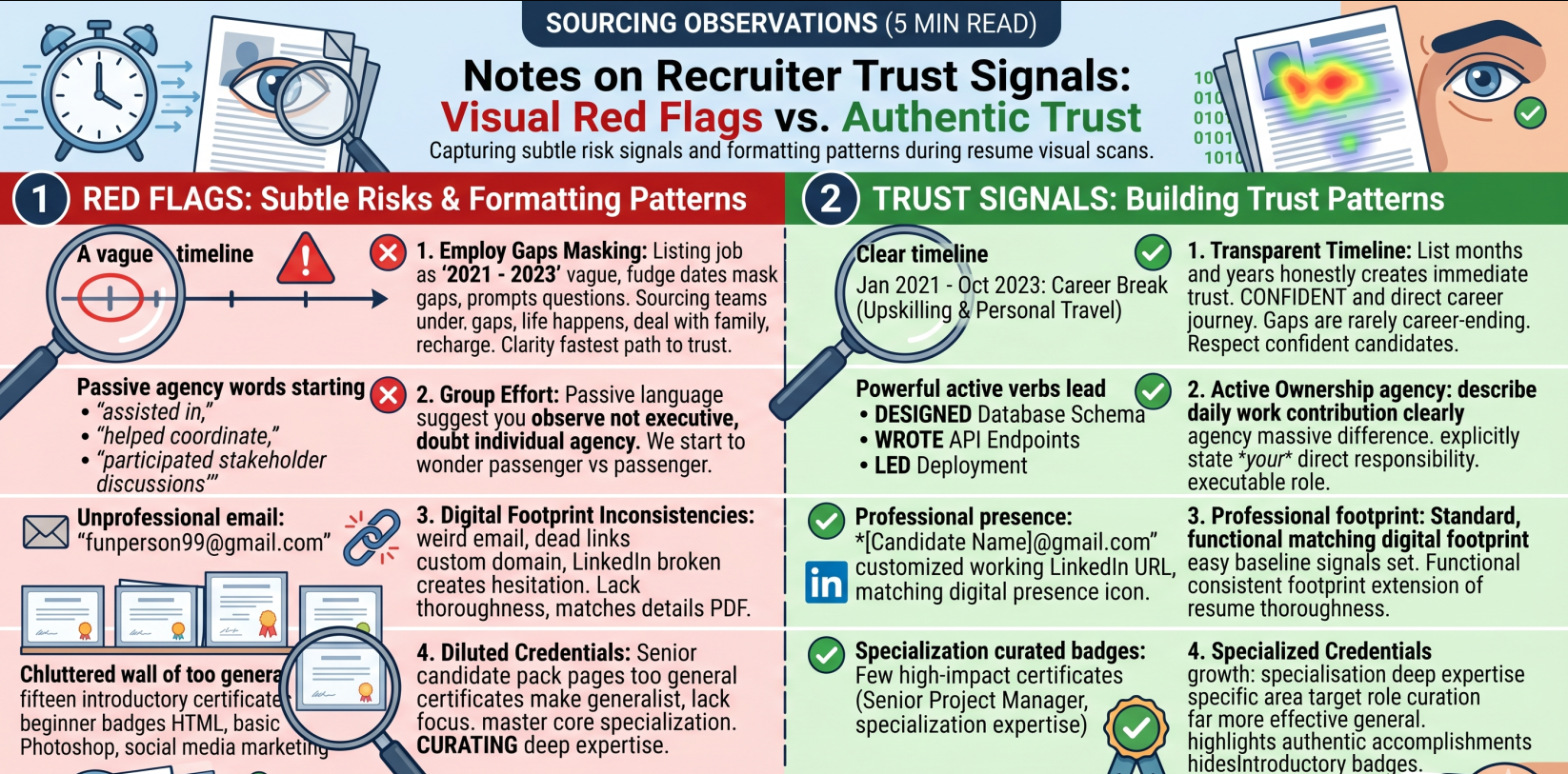
Gaps in employment are rarely the career-ending obstacles candidates assume they are. Sourcing teams understand that life happens—people take breaks, deal with family, or simply need to recharge.
The actual hesitation comes when a candidate tries to hide those gaps by fudging the dates or using year-only formatting. Listing a job as *'2021 - 2023'* to mask a ten-month gap in between usually backfires. Sourcing managers notice year-only timelines instantly, and it prompts us to ask detailed timeline questions during the initial call. It's much easier to just list the months and years honestly on the page.
When your timeline is clear and transparent, it creates immediate trust. If you took a six-month break to upskill, care for a family member, or travel, listing it as a simple, one-line note like *'Career Break (Upskilling & Personal Travel)'* is completely normal. Recruiters don't expect you to be a flawless machine that has worked every single day of the last ten years. We respect candidates who are confident and direct about their career journey. Trying to hide details under vague formatting just makes us spend more time auditing your history instead of focusing on your accomplishments.
Clarity is the fastest path to trust in a sourcing pipeline.
The words you choose to describe your daily work say a lot about your level of ownership on a project.
One of the most common warnings we see is a resume filled entirely with collaborative, passive fluff. When every bullet point begins with phrases like *'assisted in,'* *'helped coordinate,'* or *'participated in stakeholder discussions,'* it raises doubts about your individual agency. We start to wonder if you actually drove the project or if you were just a passenger sitting in the room.
We want to know what *your* specific contribution was. If a team of ten people built a platform, what was your direct responsibility? Did you design the database schema, write the API endpoints, or lead the deployment? Using clear, active verbs that demonstrate personal agency makes a massive difference. You don't need to sound like a lone hero who built the whole company, but you do need to make your individual contribution explicit. Passive language usually suggests you were just observing the work rather than executing it.
Describe your own contributions clearly rather than hiding behind a group effort.
It sounds incredibly simple, but your digital footprint is often the first thing we look at after reading your achievements.
An email address like *'funperson99@gmail.com'* or a custom domain link that leads to a dead hosting page can raise subtle questions about readiness. The same thing happens when a candidate includes a custom LinkedIn link that is broken or doesn't match the job history listed on the PDF. Sourcing managers check these details quickly, and inconsistencies usually create a hesitation to move forward.
Your online presence should be a simple, functional extension of your resume. A standard, professional email address using your name and a customized, working LinkedIn URL are the easiest baseline signals you can set. If you link to a personal portfolio or a GitHub repository, make sure the project links work and the code represents your current skills. We don't expect a viral social media presence; we just want to see a functional, consistent digital footprint that matches the details you wrote on your PDF. Inconsistencies there usually suggest a lack of thoroughness.
A matching, working digital presence is the easiest trust signal you can send.
Adding credentials to your resume is a great way to show growth, but listing too many unrelated badges can actually dilute your value.
We see this constantly with mid-level or senior candidates who pack their pages with fifteen introductory certificates in completely different fields. If you are applying for a Senior Project Manager role, listing beginner badges in HTML, basic Photoshop, and social media marketing can make you look like a generalist who lacks a clear focus. It can make hiring managers worry that you haven't mastered your core specialization.
Specialization is what gets you noticed in a competitive market. Sourcing teams look for candidates who have deep expertise in a specific area. Curating your certifications to match the target role is far more effective than listing every online course you have ever completed. If a badge doesn't directly support your specialization or the role you are applying for, it is usually best to leave it off. It keeps your resume focused, clean, and highlights your actual high-impact accomplishments instead of hiding them behind a wall of introductory badges.
Hiring teams are always under time pressure, and we get tired of looking at files that feel over-optimized. You do not need to worry about secret algorithms or trying to game a scanner. Just check your spelling, keep it honest, and write down what you actually built. In the end, that's usually where the trust starts.