Professional Writing Authority

The Resume Writing Guide: How to Stop Writing Resumes That Get Ignored.

Most resumes fail because they are poorly written, not because the candidate lacks experience. Learn how to write high-impact sentences that convert into interviews.

Quick Answer: How to Write a High-Value Resume?

High-value resume writing is about proof of impact, not a list of duties. It requires shifting from a passive history ("Responsible for...") to an active achievement narrative ("Increased revenue by..."). A Top 1% resume uses the Action + Task + Result formula for every bullet point, prioritizes clarity over industry jargon, and is engineered to pass the 6-second recruiter scan by front-loading value.

1. The Difference Between Writing and Just Listing

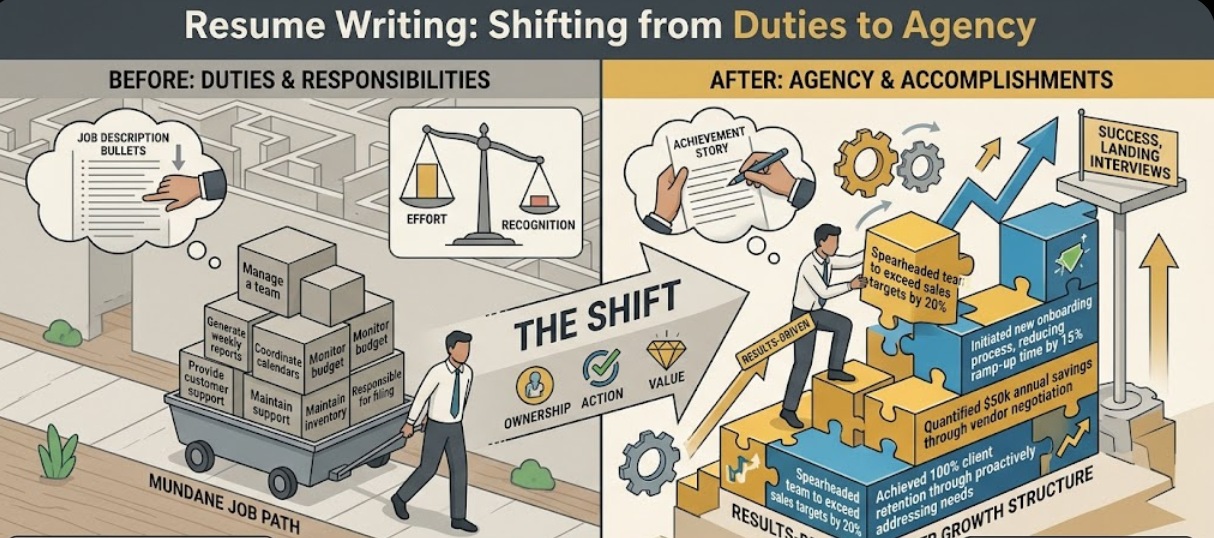
Most resumes fail because they are simple lists of tasks. A list is a grocery bill; writing is a marketing document. A list tells the recruiter what you were expected to do, but it doesn't tell them what you actually delivered.

When you list, you sound like every other applicant. When you write with impact, you become a "must-hire."

Weak Listing (Passive)

"Managed the regional sales team and helped with marketing efforts."

Strong Writing (Active)

"Led a 12-person sales team to Exceed Annual Targets by 22% through a restructured GTM Strategy."

2. How to Write Resume Content That Actually Converts

The goal of your resume is not to get a job—it's to convert the recruiter's attention into a phone call.This requires a shift in mindset. You are not the hero of this story; your accomplishments are the solution to the company's problem.

  • Front-Load the Action: Never start a bullet point with "I" or "Responsible for." Start with a powerful action verb like Negotiated, Spearheaded, or Orchestrated.
  • Add Contextual Depth: Don't just say "Handled budgets." Say "Managed a $2M annual OPEX budget across 4 departments."
  • Evidence of Success: Every claim must have a receipt. If you say you are a "leader," show us the team size and the outcome of your leadership.

3. Engineering an ATS Resume: Writing for Bots and Humans

An ATS resume must balance two audiences. The software (ATS) is looking for specific hard skills and standard nouns. The human (Recruiter) is looking for proof of competence and narrative flow.

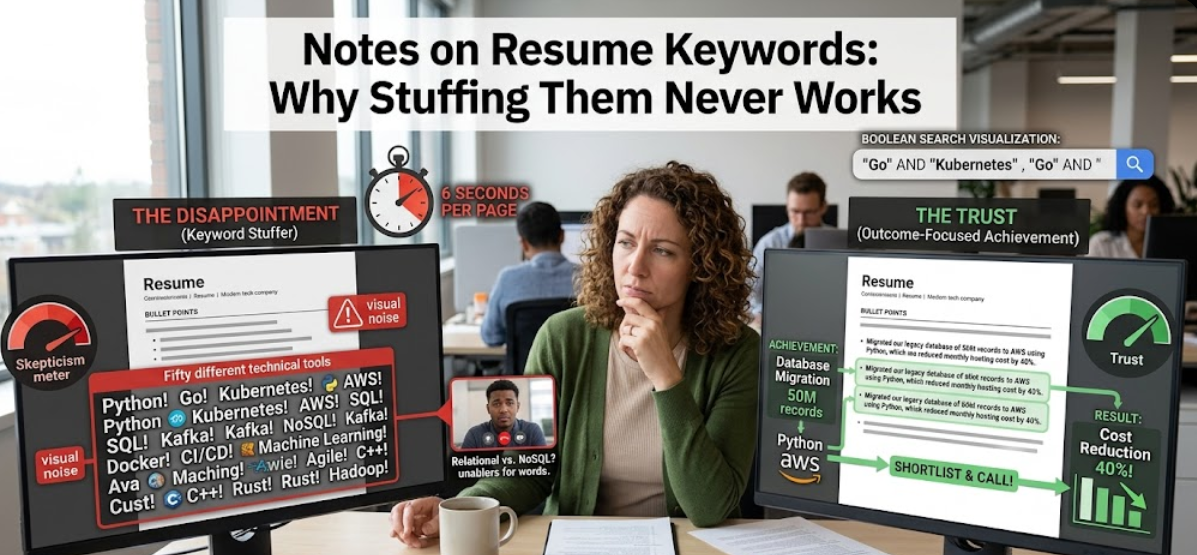
Generic sentences get ignored. To pass both filters, you must naturally integrate keywords into your achievement stories. Do not just list "Python" in a skills box; write about how you "Used Python to automate a reporting system that saved 20 hours per week."

  • Keywords as Nouns: Identify the most common hard skills in the JD and make them the subject of your bullets.
  • Standard Formatting: The best written content is useless if the bot cannot parse it. Use standard section headers.

4. High-Impact Resume Writing Tips: Why Weak Sentences Fail

Weak writing is the fastest way to get rejected. Weak sentences are passive, vague, and lack confidence. In our resume writing tips, we emphasize "Active Voice" as the foundation of influence.

Weak Language Trap
  • "Helped with the implementation of a new software."
  • "Was involved in various marketing projects."
  • "Duties included answering phones and client support."
The 1% Rewrite
  • "Spearheaded the Implementation of a CRM system for 150+ users."
  • "Orchestrated 4 High-Impact Marketing Campaigns resulting in 2k leads."
  • "Resolved 50+ Client Support inquiries daily with a 98% satisfaction rate."

5. Why Clarity Beats Complexity in Professional Writing

Many candidates believe that using big words and complex sentences makes them sound smarter. It doesn't.It makes your resume harder to read in the 6-second scan.

The best resumes use simple, punchy language that gets to the point immediately. If a recruiter has to read a sentence twice to understand what you did, you have already lost.

  • Omit Needless Words: Instead of "In order to improve the productivity," say "To boost productivity."
  • One Idea Per Bullet: Don't try to cram three different tasks into one sentence. Split them up.

6. Moving Beyond Duties: Why Results Matter More Than Tasks

A recruiter doesn't care that you "attended meetings" or "wrote reports." They care about the outcome of those actions.

Every bullet point should answer the question: "So what?" If your bullet point doesn't end with a result, it's a wasted line.

The "So What?" Test:

"Managed a team of 10." (So what?)
"Managed a team of 10 to deliver a product 2 weeks early, saving $50k in overhead." (There it is.)

7. The Secret Writing Formula: Action + Task + Result

To achieve Top 1% quality, use this formula for 80% of your work experience bullet points.

Action

"Spearheaded"

Task

"a $200k sales campaign"

Result

"that generated $1M in revenue."

Why this works: It starts with energy (Action), defines the scope (Task), and proves the value (Result). It is mathematically impossible to write a weak sentence using this framework.

8. Real-World Resume Examples: Transformations That Win

Weak Sentence
Optimized Writing
"Worked on the company's new website design."
"Optimized **UI/UX Design** for a SaaS platform, improving **Conversion Rate** by 18%."
"Helped organize the annual company conference."
"Orchestrated Event Logistics for a 500-person conference, under-budget by $5k."

9. Fatal Resume Mistakes: Why Generic Language Fails

Recruiters see "Generic Language" as a lack of effort or a lack of real experience. If your resume uses these words without context, you are being ignored:

HardworkingTeam PlayerSelf-motivatedDetail-orientedPassionateResults-driven

The Optimization Fix: Don't tell them you are "detail-oriented." Prove it by describing how you "Identified a $12k accounting error during a standard audit."

10. Recruiter Psychology: Mastering the 6-Second Scan

A recruiter's first pass is purely visual and binary: "Does this person meet the core requirements?"They scan the top 1/3 of the first page and the bullet points of your most recent role.

  • Hierarchy of Value: Your most impressive achievement should be the very first bullet point under your most recent job.
  • The Boldness Strategy: Use bolding to highlight **Quantified Results** and **Hard Skills**. This guides the recruiter's eye toward your "signal."

The Resume Writing Checklist

No sentences start with 'Responsible for'
80% of bullets include a metric ($, %, #)
Action verbs are diverse (no repetition)
Hard skills are naturally integrated
Summary focuses on ROI for employer
No generic adjectives (hardworking, etc.)
Clear hierarchy of value (top-down)
Grammar and tone are consistent

Frequently Asked Questions

Should I use the same writing style for all sections?

Yes. Consistency in tone and structure (Action + Task + Result) creates a professional narrative. Changing styles halfway through makes the document look like a 'Frankenstein' of copied templates.

How do I write about results if I don't have numbers?

Use qualitative impact. Did you 'Improve workflow'? Did you 'Reduce errors'? Did you 'Increase customer satisfaction'? If you can't measure it in dollars, measure it in time saved or process stability.

Is first-person writing (I, me, my) okay?

Generally, no. In standard resume writing, the 'I' is implied. Instead of 'I managed the team,' write 'Managed the team.' It's punchier and saves space.

How do I handle resume writing for a career change?

Focus on 'Transferable Skills.' Instead of writing about industry-specific tasks, write about the 'Meta-Skills' (e.g., Problem Solving, Strategic Planning, Negotiation) that apply to the new role.

Ready to write your Top 1% Resume?

Use our AI-driven tools to ensure your writing matches the highest professional standards.