The 3-Line Sales Pitch: Why Your Resume Summary Makes or Breaks the Hire
Most resumes start with a "Career Objective" that reads like a request for a favor. Writing "Seeking a rewarding opportunity to grow my career" is a signal to a recruiter that you’re focused on your own needs rather than their operational problems. A professional summary, by contrast, is a value statement. It’s the brief opening pitch at the top of your page that explains exactly what you can contribute to the team on your first day. If you don't engage them in those first few sentences, they may never bother to look at your technical skills or background.
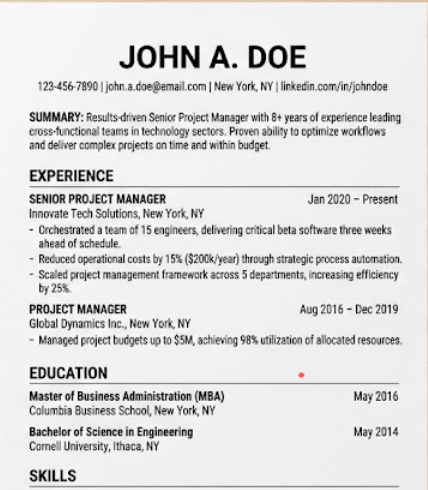
Professional Placement: The summary acts as the anchor at the top of your document, setting the context for your entire career history.
The 6-Second Reality
When I’m reviewing a stack of resumes, my eyes naturally filter out empty descriptions. Phrases like "highly motivated," "team player," and "hard worker" carry very little weight because they lack context. Instead, I’m scanning for specific job titles, duration of experience, and concrete results. A practical summary tells me: "I am a [Job Title] with [X] years of experience using [Tools] to deliver [Outcome]." If I see that clarity, I keep reading. If I see a generic paragraph about a "passion for excellence," I usually move on. It’s not meant to be harsh; it’s simply the reality of managing hundreds of applications in a limited window of time.
The Rahil Patial Transformation: From 77 to 82
Think about a candidate we worked with, Rahil Patial. His original resume was honest, but it lacked a clear focus. It scored a 77 in our system because his summary was too broad, trying to cover testing, development, and support all at once. By narrowing his narrative to highlight his core stack—Node.js and React—and one significant project outcome, his score improved to 82. This wasn't just about the score; that improvement meant his profile finally aligned with what automated filters and hiring teams were actually looking for.
The difference was his decision to specialize. He stopped trying to be a generalist and started presenting himself as a specialist who had already handled the exact challenges the company was facing. By replacing vague adjectives with specific tools and verifiable achievements, he moved from being a "maybe" to a qualified candidate. This is the logic behind our 800-word strategy: every sentence needs to provide a clear indicator of your capability so the recruiter doesn't have to guess if you’re a fit.
The Non-Negotiable Rules
1. Ditch the first-person pronouns.
Never use "I," "Me," or "My." It sounds unprofessional and takes up space. Instead of "I managed a team," write "Managed a team of 10." It's cleaner, faster to read, and matches the standard "telegraphic" style of modern resumes.
2. Three sentences is the sweet spot.
If your summary is a wall of text, it won't be read. If it's one line, it looks empty. Aim for three powerful sentences: who you are, what you’ve done with what tools, and what you’re looking to achieve for them.
3. Mirror the Job Description exactly.
If the JD asks for a "Client Success Specialist," do not call yourself a "Customer Service Rep." Use their language. This isn't lying—it's translating your experience into the vocabulary of the company you want to work for.
4. Numbers are your best friends.
A summary without a metric is just an opinion. Did you save time? Did you increase revenue? Did you reduce errors? If you don't have a number, you haven't finished writing your summary yet.
Role-Specific Strategies
Technical & Engineering Roles
In tech, the summary is about your "Stack and Scale." A recruiter needs to know immediately if you use the same languages they do and if you've worked on systems of a similar size. Don't just list languages; describe how you used them. For example: "Full-Stack Developer with 5 years of experience in React and Node.js. Optimized database queries for a high-traffic fintech platform, reducing latency by 40% for 100k+ monthly active users." This tells me you know the tools AND you understand performance.
Marketing & Sales Professionals
If you are in marketing or sales, your summary must scream "ROI." I don't care that you "ran campaigns"; I care that those campaigns made money. A strong summary looks like this: "Growth Marketer specializing in Paid Acquisition and SEO. Scaled monthly recurring revenue (MRR) from $50k to $150k in 12 months through targeted LinkedIn ad strategies and content optimization." This is pure value. It shows you aren't just an expense; you are an investment.
Freshers & Career Changers
For a fresher, the summary is about "Potential and Certification." Since you don't have a work history, focus on your specialized training. "Certified Data Analyst (Udemy/LinkedIn Learning) with a background in Computer Science. Developed a mock financial forecasting tool using Python that automated data entry for 200+ records. Eager to apply analytical rigor to the junior team at [Company]." This shows you've spent your free time building skills, which is the number one signal a recruiter looks for in a beginner.
The Human Truth of Summaries
Think of your summary as an authentic representation of your professional background. It’s not about finding the most impressive-sounding words; it’s about accurately conveying your skills and your actual experience. A recruiter is looking for evidence of your work in the field. When an HR professional opens your resume, they generally look at the summary first. If those opening lines don't demonstrate that your background aligns with the job requirements, they may not spend time looking at the rest of your credentials.
This is why your summary needs to be concise and targeted. It serves as a bridge between the company's needs and your specific expertise. There is also a practical standard to follow: the summary should always be at the very top. Placing it elsewhere can make the document harder to navigate. It sets the context for everything that follows, and if it feels grounded in reality, you’ve cleared the first hurdle in the hiring process.
The "Jack of All Trades" Trap
I often see candidates listing skills in development, testing, and UI/UX all in the same summary. They believe this makes them look versatile, but it often makes their core expertise harder to identify. If I am hiring for a Backend Engineer and your summary focuses heavily on design tools, I may assume you aren't the right fit for the technical requirements. A targeted approach is often more effective in a competitive market. Choose your primary area of expertise and ensure your summary is precisely targeted toward that specific role's requirements.
Build a Summary That Actually Works.
Stop guessing what recruiters want. Use our tool to find the right metrics and keywords for your specific industry.
Truth Test
Everything in your summary will be tested. If you say you're an "Expert," be ready to prove it in the first 5 minutes of the interview.
Spacing Focus
Keep your summary to 3-4 lines max. White space is just as important as the text itself for human scannability.
JD Alignment
Never use the same summary twice. Tweak the keywords for every single application to match the exact requirements of the job.