Notes on Resume Keywords: Why Stuffing Them Never Works
A few casual thoughts on why copying every skill in the job description looks fake, and what actually makes a resume feel trustworthy during a screening call.
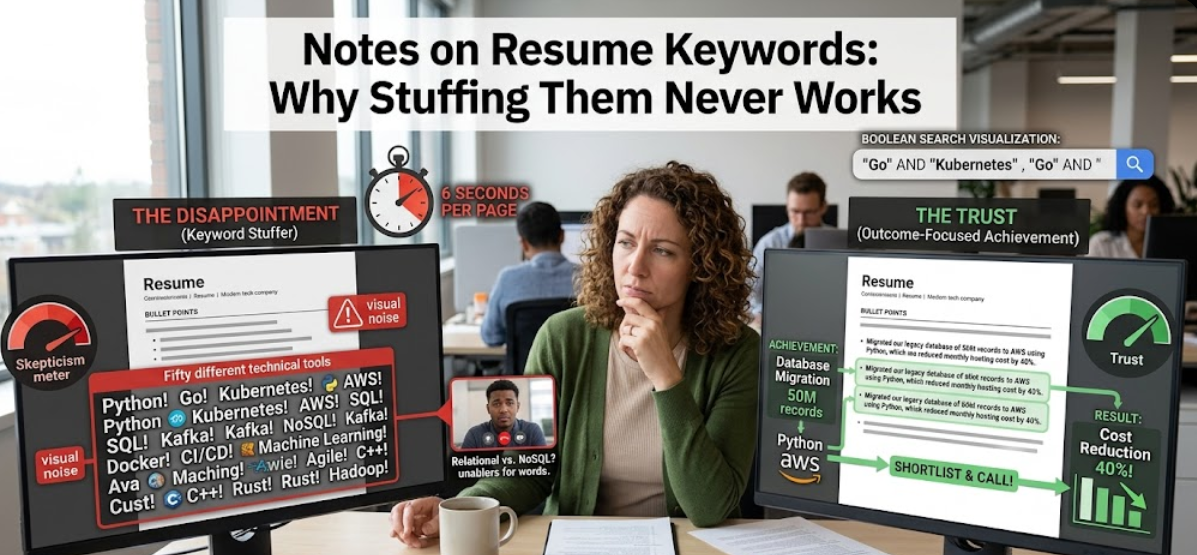
When I'm sourcing for a hard-to-fill role, my biggest frustration isn't finding people. It's finding people who actually know what they say they know. I open our search bar, type in a few basic skills we need, and filter the list. But as soon as I click on a file and see a massive wall of fifty different technical tools pasted at the bottom, I immediately get skeptical.
Sourcing fatigue is very real. After looking at two hundred resumes in a single afternoon, every file starts to blur together. They all use the exact same templates, the exact same verbs, and the exact same buzzwords. When I open a resume and see another generic skill list containing thirty different programming languages and cloud platforms, my eyes just glaze over. It feels like reading a dictionary page rather than a human career. We are desperate to see a simple, honest story about what a person actually built, but instead, we get copy-pasted job descriptions.
When you paste every database, backend framework, and cloud technology into a big block, it looks fake. It looks like you're trying to game a system rather than describing your real work. A recruiter might find your resume in a search, but the moment they see that block, they think: there is no way one person is an expert in all of this. It instantly triggers our skepticism.
Sourcing managers are searching fast—we don't have time to try ten different typos to locate your profile. If the hiring manager wants someone who knows Go and Kubernetes, we type those words in. If you have those skills but spell Kubernetes wrong, you just won't show up in the results. Simple spelling checks are usually enough.
I once called a candidate whose resume looked ideal at first glance. They had listed every single database and framework under the sun. But three minutes into our initial call, they couldn't explain the basic differences between a standard relational database and NoSQL.
They had the keywords, but zero actual context. It was an incredibly disappointing call, and it made me reject the application immediately. Just listing skills without attaching them to real achievements ruins your credibility during calls.
If you list a skill on your resume, you need to prove you've actually used it.
This is the biggest contradiction in modern hiring: resumes are looking more polished than ever, but actual interview performance is dropping. A candidate's file might claim they are a lead system designer who knows five different cloud environments. But when they get on a call with a technical lead, they struggle to draw a basic diagram of a simple client-server connection. It makes recruiters incredibly skeptical of everything on a page. The moment we spot a single over-embellished bullet, we start questioning every other date and achievement listed. Honesty isn't just a moral choice; it's a structural requirement.
On the other hand, the most frustrating part of my job is seeing candidates who actually have fantastic experience hide it under awkward, vague language. I've seen engineers who built major core infrastructure systems write bullets like *"Responsible for maintaining legacy codebase."* That tells me absolutely nothing! They hide their actual technical achievements because they are too busy trying to fit fifty irrelevant keyword tags at the bottom. They are spending all their energy trying to optimize for search filters, and in the process, they completely erase the human value of their actual work.
The resumes that actually stand out are the ones where I can see the tools used directly inside the achievements. It makes the resume feel honest and saves me from having to guess what you actually did.
"Used AWS, Python, and SQL to migrate a database."
"Migrated our legacy database of 50M records to AWS using Python, which reduced monthly hosting cost by 40%."
It tells the recruiter exactly how you applied your skills, rather than just claiming you know the tool.
Hiring teams are always under time pressure, and we get tired of looking at files that feel over-optimized. You do not need to worry about secret algorithms or trying to game a scanner. Just check your spelling, keep it honest, and write down what you actually built. In the end, that's usually where the trust starts.