The Passive Voice Epidemic: Why "Responsible for" is Killing Your Resume
Show clear ownership and measurable impact instead of reciting a passive list of daily duties.
How Active Verbs Transform Your Experience
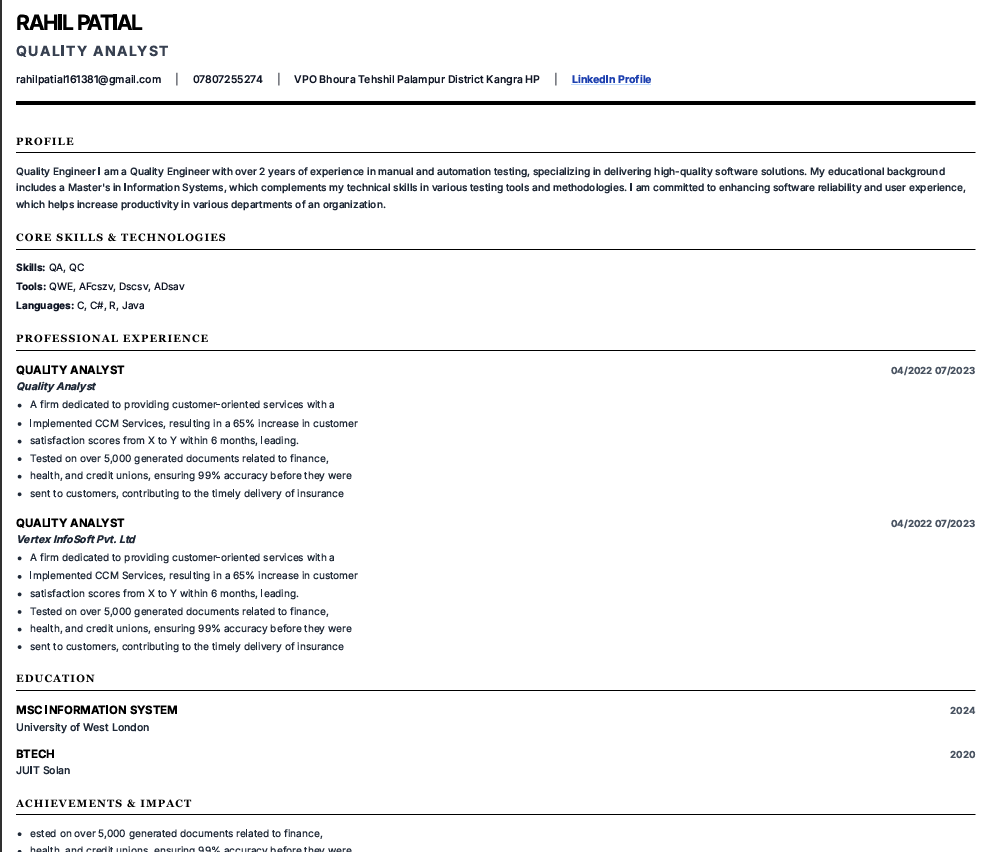
I’ve read thousands of resumes, and there is one phrase that makes me want to stop reading instantly: "Responsible for." It’s the linguistic equivalent of a shrug.
When you use passive language like "assisted in" or "participated in," you're telling the recruiter that you were in the room, but you weren't necessarily the person making things happen. In a high-volume hiring environment, I’m looking for candidates who show clear ownership of their work. I want to see words that imply direct responsibility and measurable impact. If you "managed a project," that’s okay, but you can make it stronger by showing your exact role and contribution. However, be careful not to overshoot—using grand, inflated verbs like "orchestrated" or "revolutionized" when you actually just helped out feels exaggerated and quickly lowers trust with experienced readers.
Most people treat their resume as a historical list of daily duties, which is a mistake that keeps their profile looking generic. A resume is a tool to prove you can solve a company's specific challenges. By swapping weak verbs for accurate, active ones, you transform your past experience from a list of chores into a series of clear results. It’s the difference between saying you "cleaned the kitchen" and saying you "maintained the workspace to meet health standards and improved efficiency by 20%." One is a passive duty; the other is a believable, practical achievement.
By shifting your focus from what you were "supposed to do" to your actual contributions, you create a realistic narrative that makes it easy for the recruiter to see you as a valuable addition to their team.
The Driver vs. Passenger Test
Whenever I review a bullet point, I ask myself if anyone else in your department could have written it. If the answer is yes, then the wording is likely too generic.
Using passive words like "assisted" or "participated" makes it sound like you were just a passive observer following orders. On the other hand, choosing words that show clear, individual contribution lets the recruiter know exactly what your part was.
A critical warning here: **accuracy is far more important than sounding impressive.** I see many junior candidates use inflated words like "architected," "revolutionized," or "spearheaded" for tasks that were actually basic maintenance or small collaborations. This is a massive red flag. When a recruiter sees a junior resume claiming they "architected a global platform," it immediately compromises their credibility. Instead of exaggerating, focus on precise ownership.
You don't need to be a manager or senior engineer to use active verbs. Even as a junior contributor, you can own your specific results. For example, instead of writing that you "worked on the new customer onboarding system," you can state that you "debugged the registration flow, resolving latency issues and making the signup process smoother." This tells a believable, honest story of ownership where your skill and the result are linked naturally.
When you start using verbs that accurately reflect your contribution, you show professional maturity that makes you stand out to experienced hiring managers.
The Verb Transformation
The Passive Passenger (Before)
"Responsible for managing the sales team and checking weekly reports."
The Active Driver (After)
"Spearheaded a new sales strategy that boosted team performance by 15% through data-driven performance reviews and targeted training."
The Passive Passenger (Before)
"Assisted in the development of a new marketing campaign for local clients."
The Active Driver (After)
"Co-authored and executed a localized marketing campaign that generated $50k in new revenue within the first three months."
Notice how the "After" examples don't just use a better word; they build a story around that word that clearly shows what the candidate did and what the actual result was.
Action Verb Library
Click through these practical action verbs to see how to describe your work with the right level of ownership and detail.
Spearheaded
Why Recruiters Love It
It tells the recruiter you didn't just participate; you were the driving force behind a brand new idea, navigating it through obstacles to completion.
Spearheaded [initiative] from conception to [milestone], resulting in [quantifiable business impact].
"Responsible for launching the new partner portal website."
"Spearheaded the design and launch of a multi-tenant partner portal, accelerating partner onboarding by 42% within 60 days."
Finding the Right Words
Don't guess which words to use. The most relevant action verbs are already present inside the job description itself.
Every team has a specific focus. Some value speed and iteration, while others emphasize structure and scale. Mirroring these verbs in your bullet points signals to the hiring manager that you understand their team's direct requirements and have relevant experience.
Using modern tools to analyze job descriptions can help you spot these patterns. Instead of using automated tools to generate generic bullet points, use them to review the description and highlight key recurring terms. This helps you understand the difference in expectations between a team that wants someone to optimize existing workflows versus one that needs someone to set up a new system. By analyzing the job posting and comparing it to your experience, you can ensure your resume is grounded in real-world contribution.
When you combine realistic self-assessment with direct research into what a team is looking for, you write bullet points that speak directly to a recruiter's daily experience.
Specificity Wins
General verbs lead to general rejection. Use specific words that describe the exact action you took and the technical context in which you took it.
Achievement Focus
Every bullet point must point to a win. If your verb doesn't lead to a measurable result, it’s probably not the right verb for a high-impact resume.
The Power of "I"
Own your actions. Even in a team setting, highlight the specific verbs that describe your unique contribution to the project’s success.
Upgrade Your Bullet Points
Stop using weak language. Use our builder to identify the strongest action verbs for your specific career path and get noticed today.