Notes on the Shortlist Queue: The Black Hole of Blind Applications

A few blunt observations on why excellent candidates get buried in the screening pile, and what actually makes a recruiter pause.
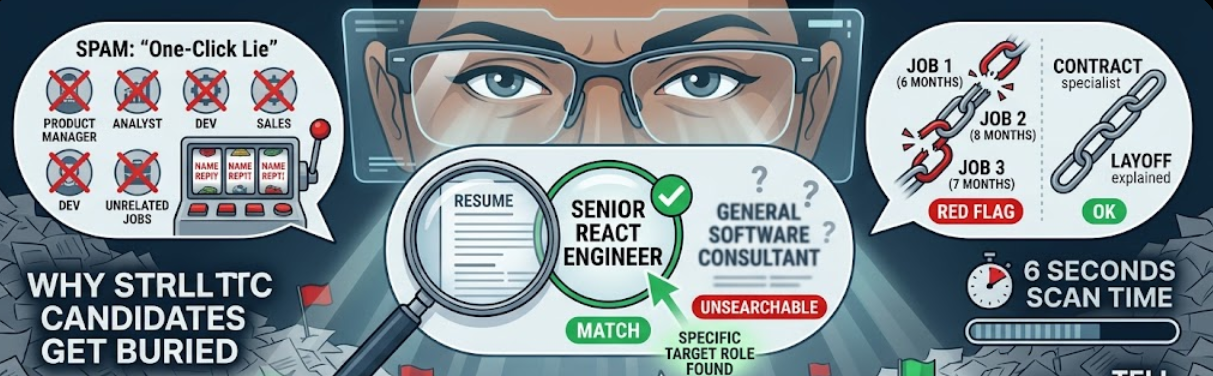
The biggest lie in modern job hunting is that applying for jobs is simply a numbers game. Candidates believe that if they just click "One-Click Apply" fifty times a day, they will eventually get lucky.
In reality, this high-volume strategy usually makes it harder to get noticed. Sourcing teams recognize repetitive names quickly. If I open my applicant queue in the morning and see your name pop up under five completely different job listings—like applying for Front-End Developer, Product Manager, and Sales Analyst all at once—most sourcing teams will probably move on. It makes it look like you didn't check the job requirements.
When your file enters our database, the very first hurdle is the automated match score. If your resume doesn't contain the primary keywords for the role, the system assigns a low score and your file is filtered out before a human recruiter even knows you applied. You have to clear that initial database gatekeeper just to get your name on our radar.
But even if you have a decent score, it is always a relative competition. Sourcing queues are sorted by score rank; if your resume scores an eighty but ten other candidates in the pool score a ninety, those ten people will get priority attention first. Sourcing managers under time pressure rarely dig past the first screen of results, so scoring high relative to the rest of the pool is what actually gets you noticed.
When you spam a single company with generic applications, the recruiting database saves every single submission under your profile. Sourcing managers can see your application history quite easily. If we see constant, miscellaneous submissions for completely unrelated roles, it usually creates skepticism. It's often more effective to target a few roles with a clear focus.
Recruiters don't read resumes to find out what you can do. We scan the very top line to see if you match the job title we are hiring for.
If our team is searching for a "Senior React Engineer" and your resume title at the top says "General Software Consultant," your file might get passed over. Sourcing managers are usually moving quickly and want to see direct matches. We see a title mismatch, assume you are a generalist, and move on to the next candidate. You need to make your target role obvious the moment we open the file.
I see this mistake constantly with highly qualified generalists who try to keep their resumes as broad as possible. They think that by calling themselves a "Technical Problem Solver" or "Multi-Disciplinary Specialist," they are keeping their options open. In reality, they are just making themselves unsearchable. Sourcing managers search for specific, explicit titles. Keeping it broad just makes it harder for the team to place you.
Representing your role accurately is usually key to keeping a screening call on track.
I once reviewed a resume where the candidate's top title claimed they were a "Lead Systems Architect" with "ten years of enterprise cloud experience." But when I looked down at their education section, their university graduation date was only three years ago. They had padded their job titles and inflated their experience level to look more impressive. It usually leads to a quick pass. Sourcing teams often look at graduation timelines and work history together to understand the context.
Highlighting senior responsibilities when your overall work history is brief often raises questions during a call. We understand that the job market is highly competitive, but over-embellishing usually backfires. If your resume claims heavy architecture ownership but the conversation stays high-level, it makes it hard to build trust. It is far better to represent your actual level honestly and highlight the real, high-impact projects you completed.
Sourcing managers look for stability, and consecutive short tenures are a massive red flag in our pipeline.
When I see a resume with three consecutive jobs that each lasted less than eight months, my immediate thought is: why would our team spend six months training this person if they are going to leave in eight? If those short stays were contract roles, freelance projects, or company layoffs, you must label them as such next to the job title. Otherwise, it can look like a pattern of short stays, and hiring teams might hesitate to move forward.
Hiring a new employee is an incredibly expensive and time-consuming process for any team. We want to know that the candidate we select is going to stay long enough to deliver actual business value. If your resume shows a history of jumping from company to company every six months without any clear explanation, we assume you'll do the same to us. You must tell the story of your transitions honestly on the page. Group short-term contract roles under a single "Contract Specialist" heading, or explain company acquisitions clearly. It's usually best to explain transitions clearly so hiring managers don't have to guess the reasons.
Hiring teams are always under time pressure, and we get tired of looking at files that feel over-optimized. You do not need to worry about secret algorithms or trying to game a scanner. Just check your spelling, keep it honest, and write down what you actually built. In the end, that's usually where the trust starts.