Resume Optimization: How to Stop Getting Ignored by the Bot and the Recruiter.
A comprehensive technical guide to improving your resume's signal density, passing the ATS filter, and landing more interviews.
Quick Answer: What is Resume Optimization?
Resume optimization is the intentional process of aligning your professional data with the specific algorithms of Applicant Tracking Systems (ATS) and the 6-second scan patterns of human recruiters. It is not just editing; it is a strategic signal boost that ensures your most relevant hard skills are indexed correctly by software and prioritized by people. An optimized resume doesn't just list tasks—it proves you are the exact solution to a company’s specific business pain.
1. What “Resume Optimization” Actually Means
In the modern job market, most resumes are average, not optimized. Many job seekers believe that fixing typos and using a professional template is enough. In reality, that is the bare minimum.
True resume optimization is the technical mapping of your experience to a job description. It involves three distinct layers:
- Structural Optimization: Ensuring the document substrate is 100% parseable by ATS software.
- Keyword Optimization: Placing high-value hard skills where they carry the most weight.
- Conversion Optimization: Using quantified achievements to trigger a "Yes" from a human recruiter.
The Optimization Fix
Problem: "Responsible for managing a team and hitting goals." (Unoptimized)
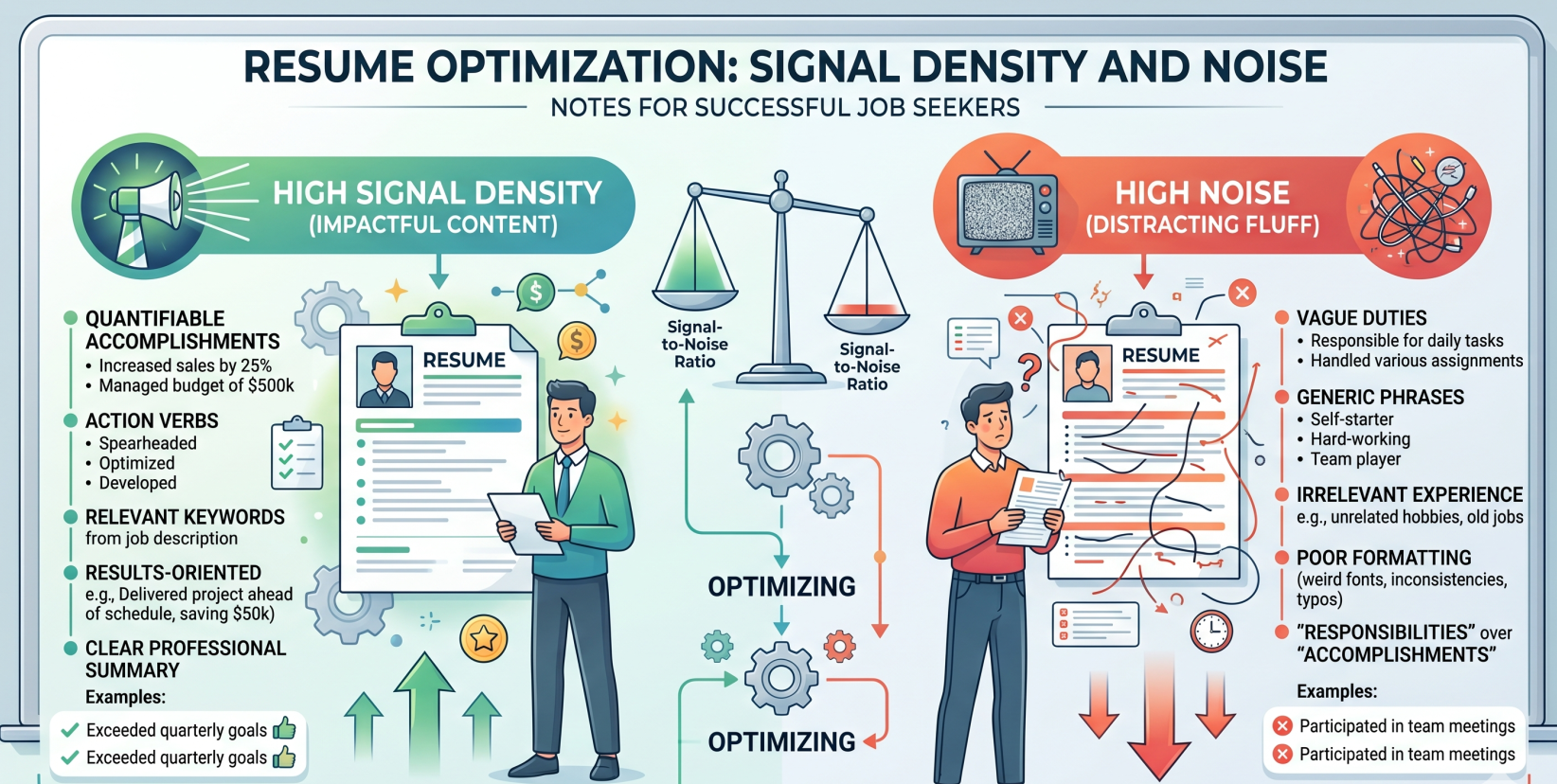
Fix: "Spearheaded a 12-person Cross-Functional Team to exceed Annual Revenue Targets by 22%." (Optimized)
2. Why Most Resumes are Under-Optimized (and Invisible)
Over 75% of resumes are rejected before a human ever sees them. This happens because most documents are under-optimized for the digital gatekeepers.
The primary reasons for under-optimization include:
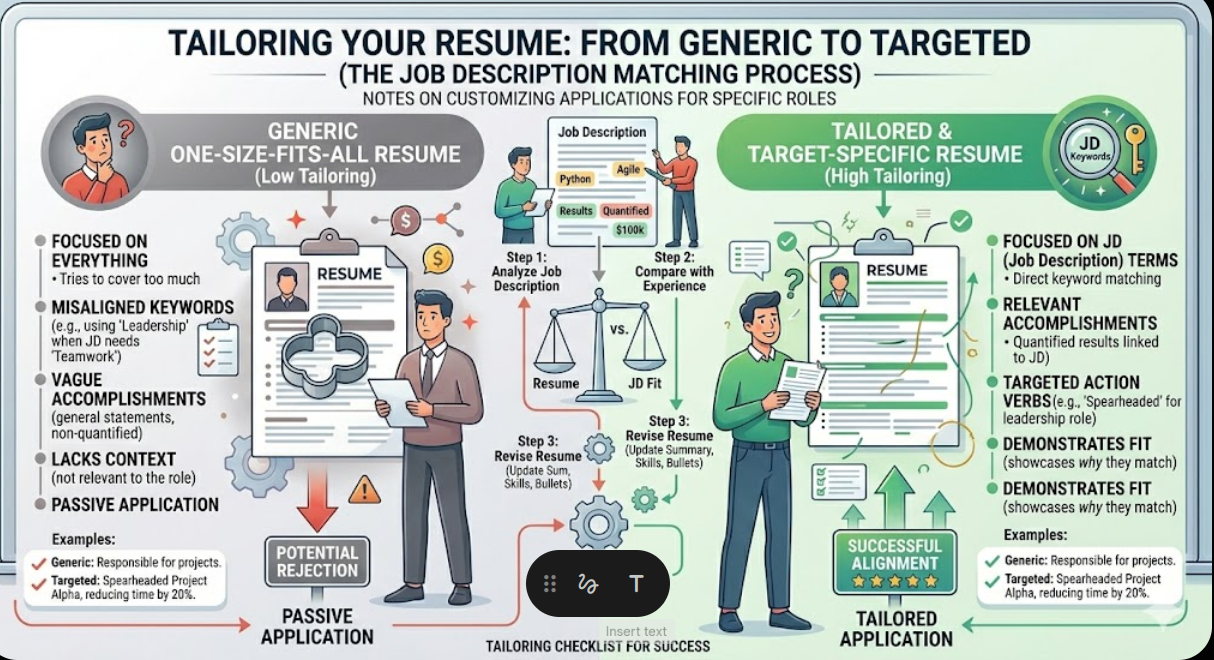
- Generic Content: Sending the same resume to 100 different roles with different requirements.
- Format Friction: Using columns, images, or text boxes that break the ATS data extraction process.
- Low Signal Density: Using vague adjectives ("motivated," "hardworking") instead of specific hard skills.
3. The Technical Difference: Good vs. Optimized Resume
A "good" resume is a passive history of your past. An "optimized" resume is an active marketing document for your future.
The "Good" Resume
- List of responsibilities ("what I did")
- Mentions skills once at the end
- Focuses on job titles only
- Standard professional grammar
The Optimized Resume
- List of achievements ("how I won")
- Reinforces keywords across all sections
- Focuses on ROI and impact metrics
- Engineered for bot and human readability
4. ATS Optimization: Passing the Digital Gatekeeper
ATS optimization is about technical compatibility. If the software cannot extract your data, your ranking falls to zero.
- Format Standard: Use a single-column, reverse-chronological layout. ATS struggle with multi-column designs.
- Standard Headers: Use "Experience," "Skills," and "Education." Creative headers like "My Journey" result in parsing errors.
- Signal Reinforcement: Repeat your core hard skills (e.g., "Python," "Project Management") at least twice to provide multiple verification points for the bot.
5. Expert Resume Optimization Tips: Placement Over Count
Most job seekers think they need to say a keyword 50 times. This is a mistake. In resume optimization, where you put a word matters more than how many times you say it.
The Summary Layer
Keywords here set the "Topic" for the entire document. Use high-level industry terms and titles.
The Experience Layer
Keywords here prove "Duration." The ATS calculates your years of experience based on the dates in this section.
6. How to Improve Resume Signal Density (The F-Pattern Scan)
Recruiters scan resumes in an "F" pattern—top to bottom, left to right. To learn how to improve resumereadability, you must place your "signals" on the left side of the page.
- Start with Action: Begin every bullet point with a high-impact action verb (e.g., Spearheaded, Optimized, Orchestrated).
- Front-Load Keywords: Put your primary skill or metric within the first 5 words of the bullet point.
- Eliminate Friction: Remove objective statements and high-school achievements to maximize "above the fold" value.
7. The 5-Step Resume Improvement Framework
Fix Structure
Convert to single-column. Use standard fonts (Arial, Calibri). Ensure no text boxes or tables.
Map Keywords
Extract hard skills from the job description. Place them in your Summary, Skills, and Experience sections.
Add Quantitative Proof
Add percentages, dollar amounts, or headcounts to every bullet point. Numbers = Signal.
Optimize Readability
Use bolding for keywords and metrics. Maintain a 60/40 ratio between text and white space.
Validate Performance
Run a score check. Ensure your resume passes the "squint test"—is the value obvious at a distance?
8. Top Resume Mistakes That Kill Your Ranking
Even a technically sound document can be destroyed by these common resume mistakes:
- Objective Statements: Outdated and selfish. Focus on your value proposition to the employer, not what you want from them.
- Vague Adjectives: Words like "hardworking" or "creative" are filler. They aren't keywords. Replace them with technical hard skills.
- Unquantified Tasks: Listing "Managed budgets" without the amount is a lost opportunity. Always specify scale.
9. Strategic Optimization Areas
Structure
Single-column, reverse-chronological substrate.
Content
Achievement-focused bullets with metrics.
Keywords
Hard-skill clusters reinforced by experience.
Readability
Bolding and white space for scan speed.
10. Before vs. After Optimization Examples
The Optimization Checklist
Frequently Asked Questions
Does the ATS really reject resumes?
No, it ranks them. If you rank #150 out of 200, a recruiter who only looks at the top 10 will never see your document. Optimization moves you from the bottom of the pile to the top.
Is Word or PDF better for ATS optimization?
Both are acceptable in 2026, but standard .docx remains the safest for data extraction across older systems. Ensure your PDF is a text-based export, not an image-based scan.
How many keywords is too many?
Focus on signal density, not count. A document that naturally integrates 15 relevant hard skills into achievement stories will always outperform one that lists 100 keywords in a block.
Should I optimize my resume for every job?
Yes. Even small variations in job titles and hard-skill requirements can impact your ranking. Aim for an 85% match with the job description's specific terminology.
Can I use AI to optimize my resume?
AI is a powerful tool for keyword mapping and rephrasing, but it needs human verification to ensure your unique achievements and tone aren't lost.
Ready to win the 6-second scan?
Don't leave your career to chance. Build an optimized resume that ranks higher and lands more interviews.